



Find where your process loses quality
Rather book a call or ask us a direction question?
You might have some questions
Yes. Polysense is configured to the specific quality parameters that matter for each product on your line. When your line changes over, the system automatically measures against the correct criteria for the product being produced.
Polysense can also automatically detect specification changes through integrations with MES or ERP systems, ensuring the right inspection settings are always applied without manual intervention.
That's exactly what it's built for. Fresh produce quality shifts with climate, growing region and supplier. Polysense measures quality continuously, so your line parameters adapt to what's actually coming in rather than staying fixed to last season's settings.
Optical sorters are only as good as the settings behind them. Most are configured once and rarely updated, because there's no live data to drive adjustments. Polysense feeds continuous measurement data back to your sorters, so their parameters stay accurate as raw material quality shifts across seasons and supplier batches.
This is exactly the problem inline measurement solves. On a high-speed line, a production fault that goes undetected for ten minutes can mean thousands of invalid products. Polysense detects drift in colour, dimensions, decoration and defects as it happens, so you can correct while the batch is still running, not after the loss has already occurred.
That's one of the most common challenges we hear in bakery today. Polysense captures the process knowledge that used to live with your experienced operators and builds it into the system. New operators get real-time guidance on what's happening and what needs attention, instead of having to rely on experience they don't yet have.
Metal detectors catch metal. They miss plastic, rubber, organic material and other contaminants that are among the most common causes of recalls in food production today. Polysense adds a vision-based layer of detection that catches what metal detectors cannot, earlier in the process and before product is packaged.
Polysense integrates with the systems already running on your shop floor, including SCADA, MES and PLC platforms. Measurement results flow directly into the systems your team already uses, including your central dashboards and reporting tools. No parallel infrastructure required.
Yes. Polysense Intelligence connects with SCADA, MES and PLC platforms, and can feed data into your existing dashboards and reporting tools. You do not need to run a separate reporting workflow. Results from Polysense flow into the systems your team already uses.
It is built for the people who run production: plant managers, quality managers and line operators. Plant managers get a line-level overview of performance and trends. Quality managers get detailed measurement data, alerts and traceability for customer complaints. Operators get real-time guidance on what is happening and what needs attention. Everyone sees the same data, in a format that is relevant to their role.
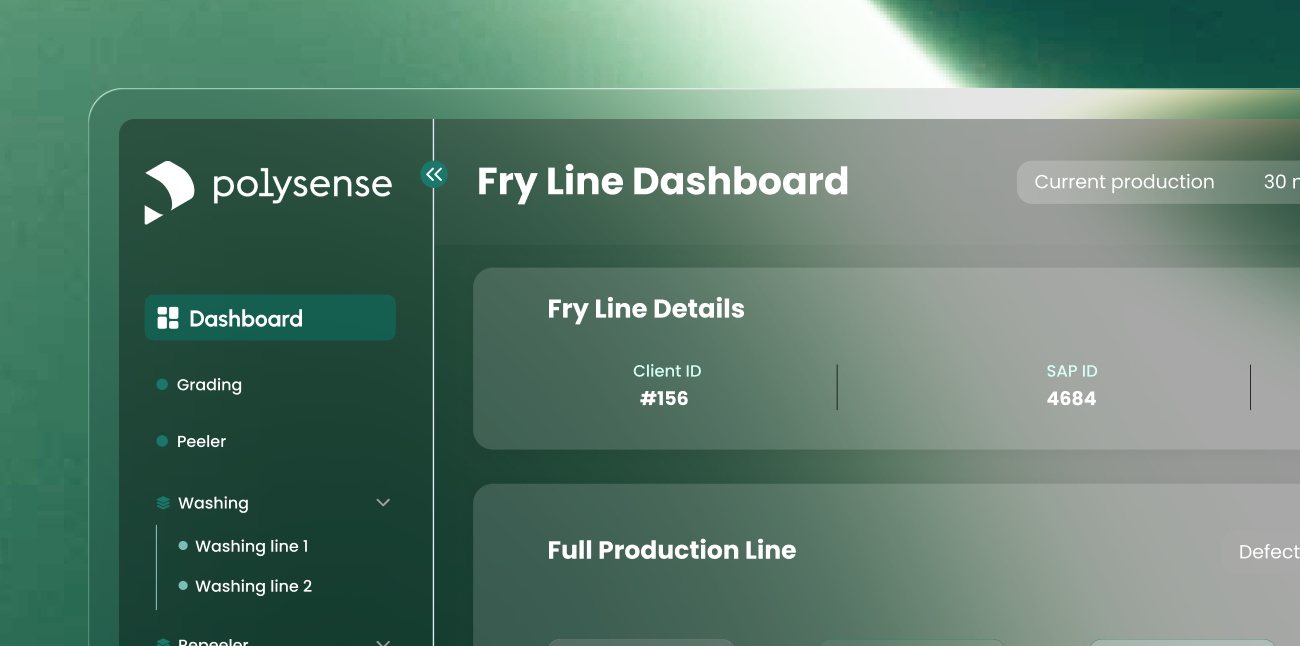
Polysense Intelligence is the platform that brings together all the data from your Polysense Qualify and Polysense AutoControl deployments in one place. It gives you a live overview of quality and process performance across your entire line, with dashboards, alerts, trend analysis and root cause tools built for production teams, not data scientists.
AutoControl communicates with your existing machines via standard industrial protocols, including OPC-UA and MQTT. In most cases, no hardware changes are required. The system connects to the control layer your machines already have.
Significantly more. In a controlled validation comparing AutoControl against manual operator control on a peeling line, AutoControl made adjustments at a far higher frequency in response to changing input conditions, resulting in lower deviation from the target and more consistent output. Manual operators simply cannot monitor and adjust at the speed and frequency that changing raw material conditions require.
Polysense Qualify measures quality and gives your team the data to make better decisions. AutoControl takes the next step: it uses that real-time quality data to automatically adjust process parameters on your machines, closing the loop between measurement and action. Where Qualify gives you insight, AutoControl turns that insight into automated control.
Results are visible in real-time dashboards, with alerts when quality drifts outside your defined thresholds. Data also integrates with your existing systems, including SCADA, MES and PLC platforms, so your team sees everything in the tools they already use.
Yes, and this is one of the highest-impact use cases. When operators set aggressive peeling settings to be safe, they lose good potato that did not need to come off. Polysense measures peel remain in real time and adjusts peeling parameters dynamically, so you peel just enough, consistently, without leaving peel behind or removing more than necessary.
Yes. Polysense is configured to detect and classify specific defect types relevant to your line and your quality standards. Whether you need itemized defect categories or a general defect rate, the system is set up around the parameters that matter for your operation and your customers.
That is exactly what it is built for. Polysense measures quality continuously, so your line parameters adapt dynamically as raw material characteristics shift across seasons, varieties and supplier batches, rather than staying fixed to settings that made sense months ago.
No. Polysense is designed to install on the line you already have. We connect to your existing equipment with minimal hardware changes, including peelers, cutters, sorters and washers. Most lines are up and running within a few weeks.
That's common. Most vision systems are built as generic tools that don't account for the realities of food processing. Polysense is different in two ways: we focus exclusively on food production, and we've built deep, hands-on understanding of how real potato processing lines actually behave. We work directly with potato processors, so the system is designed around yield, variability and production constraints, not lab conditions.
Manual quality control depends on samples taken at intervals, typically once an hour or less. By the time a problem shows up in a sample, large volumes of affected product have already been processed. Polysense Qualify detects issues the moment they appear and alerts your team while there is still time to act. It also removes the subjectivity that comes with operator-dependent inspection, so your quality measurements mean the same thing on every shift.
Polysense Qualify measures product quality inline, in real time, at production speed. It uses vision systems to detect defects, measure dimensions, monitor colour and identify foreign material continuously across your production line. Where manual sampling might inspect one in every ten thousand products, Qualify measures everything, giving you a representative and objective picture of what is actually happening on your line.